No guessing, and how we know
In most sudoku apps a hard board is a board where you eventually have to try a digit and see. Here a wrong digit costs a life, so that would just be a coin toss. The game promises something stricter.
The promise
Every board has exactly one solution, and you can reach it by reasoning alone. A harder floor asks for a better technique, never for luck.
How a board is made
- The game builds a full, valid grid from the run’s seed.
- It removes digits one at a time, and after each removal checks that exactly one solution is left.
- It then plays the board itself, step by step, with three layers of technique and nothing else: a square that has only one digit left; a digit that fits only one square in its row, column or box; and pairs, hidden cages and thermometer limits, the more advanced steps that the later floors use.
- If the board cannot be finished with those, it is thrown away and made again. If it can, the technique it needed sets how hard the floor is.
This runs for every board, on your device, before you see it. There is no list of “approved” boards and no board that was only tested once.
The same holds for the extras
- Hidden cages (the Library bosses) are only hidden when the board stays unique without them, so a hidden cage can never leave you guessing.
- Relics depend only on the seed and the floor, and all three on offer are shown. Nothing is rolled while you watch.
- The seed decides a whole run: the same seed gives the same boards and the same relics.
Teaching it
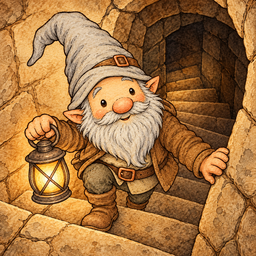
Two short, optional lessons with Nikkel the gnome show the two basic techniques on real boards. After that you will find the others yourself, and the Lantern relic points at the easiest next square.
What is checked, and what is not. The solver proof above is automated and runs on a large set of seeds in the game’s test suite. How difficult the floors feel to a person has only been estimated with a simulated player, and is yet to be tested on real ones.